I heard the claim on a podcast, and the engineer in me had to check it. On The Rest Is Science, Hannah Fry and Michael Stevens floated a great what-if: if all 8 billion of us clapped together, we’d make a noise in the 200-decibel range. That number is basically right — for the assumption behind it. So I’m not here to take apart the math. I’m here to build the thing and show you where reality steps in.
Why 200 dB is a fair theoretical limit
Sound doesn’t add like normal arithmetic — it adds by intensity. Pile every clap onto a single point and the math really does climb into the ~200 dB range. In engineering we call that a theoretical limit: the absolute max the equation allows, if nothing in the real world got in the way. Michael took the equation to its limit. Perfectly fair. The catch is the assumption — everyone on top of each other, in one spot — and 8 billion people can’t occupy the same point, because people take up space.
The escape hatch: a human phased array
In communication systems we use a phased array — a grid of emitters, each fired at just the right instant so their waves line up into one big coherent wavefront. If we timed 8 billion claps the same way, could we focus them? Partly. But the atmosphere fights back. Air isn’t uniform — temperature and density vary from spot to spot, and that smears the wave as it travels. There’s a hard coherence limit (the Maréchal criterion, λ/15 ≈ 0.42 radians of phase error) beyond which claps stop adding in phase. Model that distortion at ~1 kHz and the coherent region works out to a radius of just 115 feet.
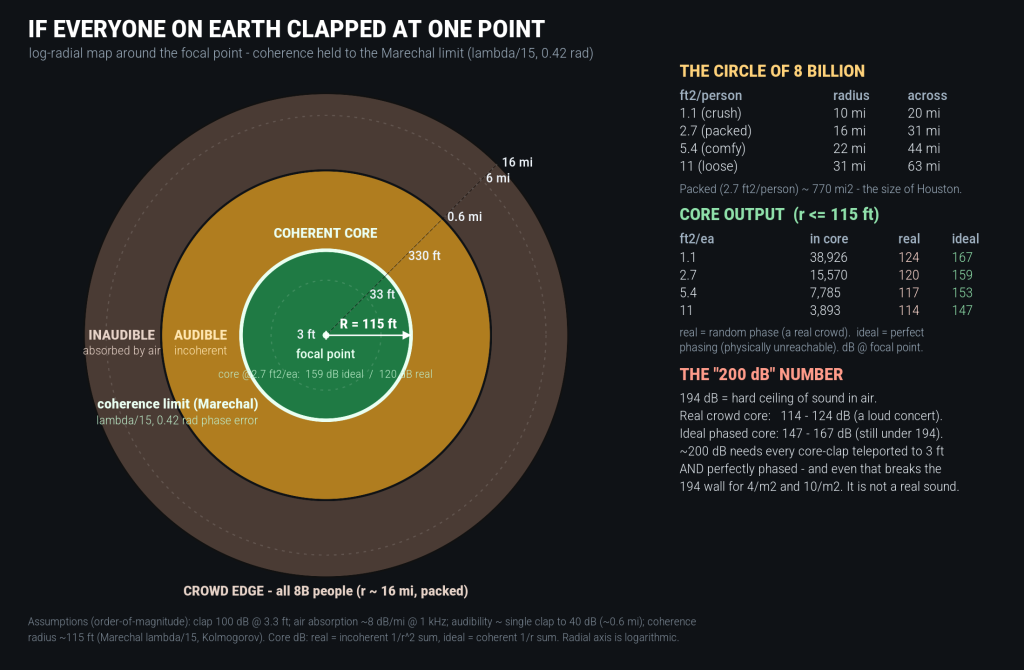

So you don’t need 8 billion people — you need the roughly 8,000 to 15,000 who fit inside that 115-foot core. Everyone past it is adding distortion, not signal. Run the real-world numbers and the honest answer is about 117–128 dB — loud, painful, concert-and-then-some… but nowhere near 200.
How you’d actually build it
I don’t think 200 dB is reachable — but I do think you could build a working human phased array. You’d need four things:
- A synchronization app — so thousands of people clap on the exact same beat.
- Matched claps — everyone’s clap needs similar frequency components (run an FFT and they should line up), or the waves won’t add cleanly.
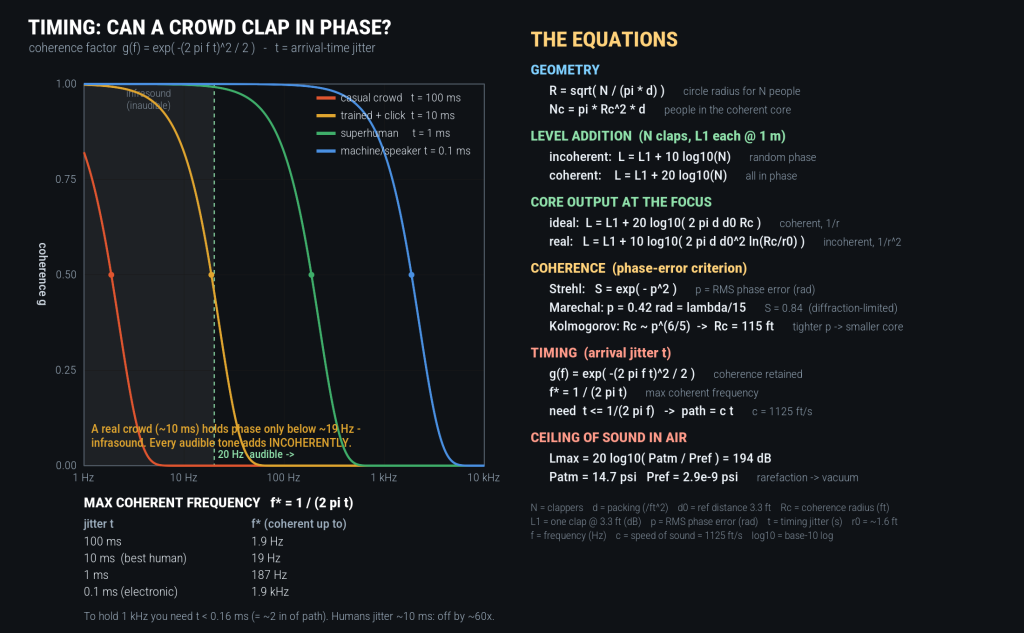
- A clap-assist device — humans self-synchronize only down to about 19 Hz, but a clap lives up near 1–2 kHz. A device that physically nudges your hands together closes that gap.
- Same height / one plane — every clap has to happen on the same plane, so a stand that sets each person’s clap to the same height.
The takeaway
Michael’s 200 dB is the theoretical limit — the number the math allows. What I love about problems like this is walking from that limit down to the real number, and finding the reason it can’t go higher: the air has a speed limit, and it’s about 194 dB. Build the best array physics allows and you land around 120 dB with a five-figure crowd. Not a planet-cracking boom — but a genuinely buildable machine, and a much better story than the number alone.
This is a MavonX Side Quest — same desk, no sudoku, just a claim worth chasing. I make original, never-repeated sudoku (and I’m going for a Guinness World Record with it). Free daily puzzles and the books are at mavonx.com. Don’t trust it — test it.